
Cultural route 5 of 6 Sounds and Flavours of the Balkans
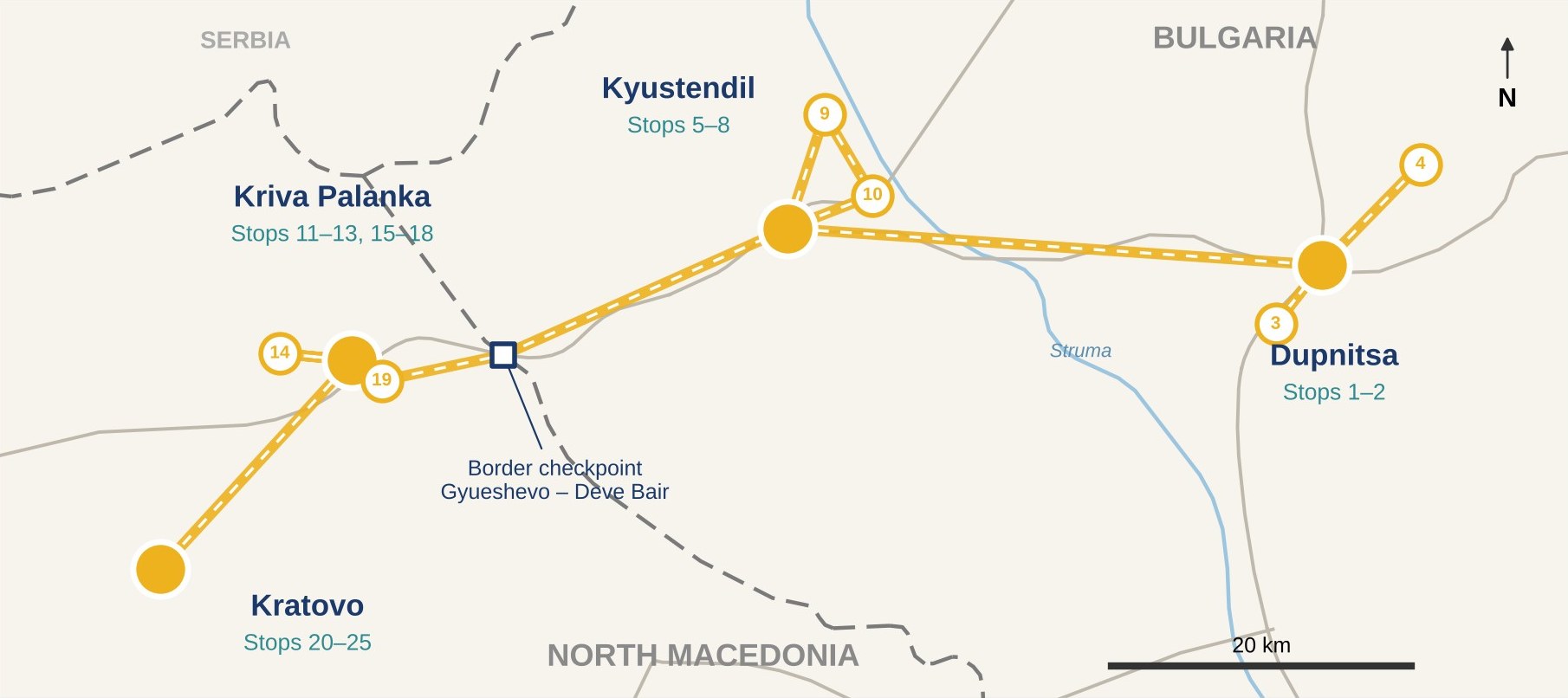
Feasts, songs and tables of the Shop region on both sides of Osogovo: 25 festivals and customs in Dupnitsa, Kyustendil, Kriva Palanka and Kratovo, each at its own time of year.
≈ 125 km town to town.
Weekend; one visit usually covers one or two towns.
All year.
Dupnitsa → Kratovo.
By car or combined.
Border checkpoint Gyueshevo – Deve Bair.
The central thesis of the route is that the cultural diversity of the region does not divide but unites, through the universal language of the senses: folk music and rhythm, and authentic traditional cuisine. The route tells the story of the people who for centuries created and passed on their culture through song, dance, traditional cuisine and feasts. In the cross-border region of Kriva Palanka, Kratovo, Kyustendil and Dupnitsa, food was never merely a necessity, nor were music and folklore mere entertainment: they were the language through which communities expressed their values and honoured the harvest, family celebrations, religious customs and the cycles of the seasons.
Despite today’s borders, the people on both sides of the Osogovo Mountains have preserved remarkably similar recipes, traditional dishes, musical instruments, horo dances and customs. The roots lie in the common Shop (Shopluk) ethno-cultural region, which existed long before today’s state borders: the population on both sides of the mountains used the same trade routes and exchanged farm produce, livestock and craft goods, and with them recipes, songs, dances and customs were passed on. Today this heritage lives on in local festivals, folk gatherings (sabori) and culinary events.
The stops are festivals and feasts held at fixed times of the year, so the journey is not one fixed day but a choice by season. The order runs from Bulgaria to North Macedonia: Dupnitsa, Kyustendil, Kriva Palanka, Kratovo. What sets the route apart is the chance to taste local specialities, hear authentic folk songs, watch traditional dances and feel the hospitality that has connected the communities of North Macedonia and Bulgaria for centuries.
Historical Museum – Dupnitsa · folklore festivals of Dupnitsa and its villages.
Stops 1–4.
Stay: Hotel “Rila”.
Eat: Restaurant of Hotel “Rila”; Plaza bar and dinner; Restaurant “Kondor”; Smoke Factory bar; “Yummy” Park-Café; Restaurant “Starata kashta”.
Regional Historical Museum – Kyustendil · folklore, cherries, bread and zelnik.
Stops 5–10.
Stay: Hotel “Ramira”; Family hotel “Konstantinovi”; Hotel “Lazur 1”; Guest houses.
Eat: Restaurant “Passione”; Restaurant “Belcanto”; Hotel-restaurant “Ramira”; Restaurant “Friends”; Restaurant “Aleya”.
City Museum – Kriva Palanka · feasts of the year and Shop gastronomy.
Stops 11–19.
Stay: Apartment Karadak; Tomato Apartment; Sirion Apartments; Home Luxury Suites; Villa “Ana Marija”; Apartments “Vodenica 3”.
Eat: Restaurant “Osogovec”; Mint Kitchen Bar; Tavern “Rege”; Restaurant “Oblače”; Restaurant “Borčeva kafana”; Ethno tavern “Vodenica 3”.
Peonia – Kratovo · culture days, wine, potatoes and k’cana sol.
Stops 20–25.
Stay: Ethno House “Shancheva”; Hotel “Kratis”; House of the Sokolovi.
Eat: Hotel “Kratis”; English Pub – Corner; Restaurant “Kuze”; Restaurant “Aleksandrija”; City kafana “Gurman”; Tavern “Kaj Spiro”.

The festival is held jointly by the municipalities of Dupnitsa and Blagoevgrad, with ensembles from Bulgaria, Morocco, Albania, Georgia, Serbia, Greece, Poland, North Macedonia and Kosovo. It takes place in May, within the May Holidays of Culture, and lasts four days under the auspices of the Bulgarian National Commission for UNESCO and the Ministry of Culture. It opens with a parade of the hosts and guest ensembles and the raising of the festival flag, followed by a concert of all participants, and continues on the “Svoboda” and “Makedonia” squares in Dupnitsa and Blagoevgrad. It is non-competitive: groups perform in the traditional costumes of their communities — Bulgarian, Armenian, Jewish, Karakachan and Aromanian (Vlach).
Dupnitsa · Address: “Svoboda” Square · Free entry · day and evening programme · 1–2 hours. More about the site.
The National Folklore Festival of arranged folk dances is held at the end of June. The first edition took place on 8–10 July 2010 in Dupnitsa, organised by the community centre “Zora 1858” and the municipalities of Dupnitsa and Sapareva Banya. Its motto is “Preserving and promoting authentic Bulgarian folklore and stimulating its development today”. The festival is competitive: dance ensembles and groups learning folk dances, and vocal groups performing Bulgarian folk songs, may take part. Its aims are to revive interest in Bulgarian folklore, to support creative contacts and to enrich the repertoire of folk groups.
Dupnitsa · Address: Rila Park · Free entry · day and evening programme · 1–2 hours. More about the site.

The gathering is held in June in the village of Kraynitsi, Dupnitsa municipality. It is organised by the village community centre and mayoralty with the Municipality of Dupnitsa. The festival gives folk singers, dancers and musicians a stage, and above all a chance to communicate through folklore with performers from all the folklore regions of Bulgaria. The organisers aim to establish it as a significant event in the village’s cultural calendar and a permanent centre for safeguarding Bulgarian folk heritage and national identity.
Dupnitsa · Address: “Bonchuk” Square, village of Kraynitsi · Free entry · day and evening programme · 1–2 hours.
The competition takes place in the second half of June on the stages of “Bratstvo 1869” and the arch on Velbazhd Square. It is organised by the community centre with the support of the Ministry of Culture and the Municipality of Kyustendil. It is open to solo performers and ensembles in folk singing, folk instruments (kaval, gaida, gadulka, tambura, accordion) and folk dance, judged by an eminent jury of folklore specialists. It brings together thousands of participants from all over Bulgaria — kindergartens, schools, community centres and folk schools — as well as foreign ensembles from neighbouring countries (Serbia, North Macedonia, Greece and others). Its aims are to preserve and develop Bulgarian folk art and give young talent a stage.
Kyustendil · Address: Velbazhd Square · Free entry · day and evening programme · 1–2 hours.

The festival is held over a weekend in the second half of June and lasts three days. The programme includes art studios and workshops, competitive cherry games, an art exhibition of cherries and cherry products, a presentation of cherry varieties for the country and the region by the Institute of Agriculture – Kyustendil, a Kyustendil cherry bazaar, an alley of crafts and festive concerts. It is organised by the Municipality of Kyustendil and is listed in the project’s Joint Cultural Calendar.
Kyustendil · Address: Velbazhd Square · Free entry · day and evening programme · 1–2 hours. More about the site.

One of the most important annual cultural events in Kyustendil, held on the last weekend of July. For three days, 200–300 performers gather — folk ensembles, dance and vocal groups from Bulgaria, the Balkans and Europe, and from as far as Mexico, Peru, Cyprus, Greece and Serbia. It is organised by the community centre “Pautalia – 2008”, led by choreographer Valentin Kenov, with the Municipality of Kyustendil. The festival is non-competitive and aims to promote and preserve Bulgarian traditions and to acquaint the public with foreign folk art. It opens with a parade along the pedestrian street, followed by a great horo in the town centre; concerts are held outdoors in front of the theatre and on Velbazhd Square.
Kyustendil · Address: 24 Bulgaria Blvd. (in front of the theatre) · Free entry · day and evening programme · 1–2 hours. More about the site.

The official spiritual feast of Kyustendil, dedicated to the Dormition of the Theotokos (15 August) and to the meaning of bread in Bulgarian tradition. It has been held every year since 2008. On 14 August, in a village of the region or in a church courtyard, master bread-makers pass their skills to young women: girls and women reap wheat ears, sing ritual songs and knead the dough with “silent water” (carried in complete silence) and holy water. On 15 August, ritual breads baked by community centres and housewives from the whole region are displayed, each decorated with relief dough symbols — crosses, grapes, suns, flowers, birds, ploughs. Priests bless the water and perform the “Elevation of the Bread”, after which the blessed bread is broken and shared.
Kyustendil · Address: Park opposite the Dormition church · Free entry · day and evening programme · 1–2 hours. More about the site.

The three-day festival takes place at a weekend in mid- or late September in the village of Shishkovtsi. It is organised by the association “Roden kray” with the community centre “3-ti mart 1911” and the Shishkovtsi mayoralty. Unlike standard folklore competitions, it celebrates crafts, traditional cuisine, everyday life and neighbourliness among the Balkan peoples, and brings together hundreds of folk groups, artists, craftsmen and cooks from Bulgaria, Serbia, North Macedonia and Greece. The “cherga” (woven rug) symbolises the interweaving of Balkan traditions; each edition has a theme, such as an exhibition of authentic rugs from Kraishte or weaving a “rug of herbs”. There are culinary contests (“The Master’s Zelnik”), tastings of banitsa and pita, a contest for the best home-made rakia, craft bazaars and evening concerts with horo dances.
Kyustendil · Address: In front of the mayoralty, village of Shishkovtsi · Free entry · day and evening programme · 1–2 hours.
A culinary-folklore event held in the village of Zhabokrat in late September or early October, after the harvest. It is organised by the community centre “Probuda 1928” with the Zhabokrat mayoralty and the Municipality of Kyustendil, and brings together cooks, community-centre activists and folk groups from the Kyustendil plain. Unlike classic banitsa, the traditional zelnik of this area has a central filling called “prazhka” or “seditsa” (often leeks, sorrel, spinach or sauerkraut), surrounded by concentrically rolled pastry sheets with butter and cheese. A contest judges taste, adherence to the traditional recipe and skill in rolling the sheets, with awards for the most authentic zelnik, the thinnest sheets, the most original filling and the youngest and oldest master. There is an all-day folk programme and a shared table.
Kyustendil · Address: Square in front of the community centre, village of Zhabokrat · Free entry · day and evening programme · 1–2 hours.

The event is held outdoors in April, around Easter by the Orthodox calendar, in the yard of the Cultural-Educational Centre in Gradec, which is being turned into an open-air museum. It is organised by the City Museum and the Municipality of Kriva Palanka. Children, families and visitors come together around the values of faith, tradition and community, with games such as choosing the most beautifully decorated and the strongest Easter egg, music and traditional games, so that the youngest learn the symbolism of Easter. The venue is decorated with Easter symbols; stalls offer handicrafts, traditional food, grill and drinks. Many guests also visit the nearby church of St Nicholas and the hermitage of St Joachim of Osogovo.
Kriva Palanka · Address: Yard of the Cultural-Educational Centre, Gradec · Free entry · daytime · 1 hour 30 minutes. More about the site.
This July evening is devoted to old-town music (starogradska pesna), tradition and the urban heritage of Kriva Palanka and the Osogovo region — a journey through time reviving the sounds, songs and customs of the past. Vocal and instrumental groups, old-town song performers, ensembles and artists from North Macedonia and Bulgaria perform; authentic staging, costumes and motifs recreate the atmosphere of old town gatherings. The stage is decorated with old-town motifs, and the amphitheatre-like summer stage gives special atmosphere to the melodies, costumes and traditional instruments. It is organised by the cultural association “Raspeani Palančani”, the Centre for Culture and the Municipality of Kriva Palanka.
Kriva Palanka · Address: Town square – summer stage · Free entry · evening · 1 hour.

A cultural-ethnological event preserving and promoting the traditional heritage of the Shop region — customs, folklore, crafts and gastronomy — and connecting communities on both sides of the border around their shared roots. Through costumes, crafts, old recipes and customs, visitors discover the Shop way of life: exhibitions of handicrafts and home products, folk performances, preparation of traditional dishes, music. It is organised by the City Museum and the Municipality of Kriva Palanka and coincides with the International Folklore Festival “St Joachim of Osogovo” (25–28 August). The venue is arranged to resemble a real “Shop village”; food is cooked in traditional vessels and ways, and young people can join thematic workshops that change with each edition.
Kriva Palanka · Address: Kriva Reka embankment by the town square · Free entry · evening · 2 hours (evening). More about the site.

A cultural-gastronomic event devoted to the traditional cuisine, customs and way of life of the Shop region, held on 8 October as part of the celebrations of Kriva Palanka’s Liberation Day. Authentic Shop dishes are prepared by local housewives from traditional recipes, and visitors — including numerous guests from many countries attending the municipal feast — discover the flavours and customs of the festive and everyday table, with a cultural programme. The setting is the ethno tavern “Vodenica 3” in the picturesque village of Duračka Reka. On the table: sarma, saramsaklii, lutenica, pindžur, ajvar, makalo, zelnik, banica, fruit preserves (slatko) and other specialities that have kept their character through the centuries.
Kriva Palanka · Address: Ethno tavern “Vodenica 3”, village of Duračka Reka · Restricted access · daytime · 1 hour 30 minutes. More about the site.
A traditional event held in June that brings together the most important cultural and artistic content of Kratovo. It is a platform for local artists, institutions and associations and for national and international guests: concerts, plays, art exhibitions, book promotions, folk performances and workshops, many held at authentic locations in the old town core, so that visitors experience the architecture and the living cultural scene together. It is held under the patronage of the Municipality of Kratovo, the House of Culture “Lazar Sofijanov” and the Ministry of Culture. From traditional skills and preserved intangible heritage to contemporary expression, the events and heritage venues introduce visitors to the architecture, folklore, traditions and gastronomy of the region.
Kratovo · Address: Town square, 10 Pavel Šatev St.; House of Culture “Lazar Sofijanov”; museum plateau and other venues · Free entry · day and evening · about 1 hour 30 minutes a day, three days.

A traditional festival celebrating folk music, dance, costume and custom, and the central event of the Days of Culture in June. It gathers folk ensembles from North Macedonia and abroad, with festive parades through the old town core, stage performances and presentations of traditional songs, dances and costumes, encouraging young people’s interest in traditional culture and strengthening ties between communities. Kratovo’s authentic setting — stone bridges, towers and old architecture — gives the festival a recognisable atmosphere, enhanced by traditional Kratovo specialities.
Kratovo · Address: Town square, 10 Pavel Šatev St · Free entry · day and evening · 1 hour 30 minutes a day. More about the site.
A two-day cultural and entertainment event in July promoting Kratovo as a town of rich historical and cultural heritage. Concerts by well-known national and regional performers and by local artists create a festival atmosphere that draws audiences from the whole country and beyond, enlivening public space and enriching the town’s summer offer. The event brings the old town core to life; visitors can enjoy the old architecture of what is often called the oldest town in the Balkans.
Kratovo · Address: Town square, 10 Pavel Šatev St · Free entry · day and evening · 2 hours.

A cultural-gastronomic event devoted to promoting and preserving the tradition of Kratovo’s famous “k’cana sol” (pounded seasoned salt), a unique local speciality and part of the town’s gastronomic identity. Prepared by an old recipe with carefully chosen ingredients and by hand, it has been passed down through generations. The event presents how k’cana sol is made and used in traditional dishes, along with other local gastronomic values, supporting small producers and gastronomic tourism. It is held on Mitrovden (St Demetrius’ Day, 8 November), when k’cana sol is traditionally made in Kratovo. The initiators are the Centre for Rock Art Kratovo and Ethno House “Shancheva”, where visitors can also take part in the traditional preparation all year round by prior arrangement.
Kratovo · Address: Ethno House “Shancheva”, 9 Skopska St. (and the town square, 10 Pavel Šatev St.) · Free entry · day and evening · 2 hours. More about the site.
The festival is held early in the year at the “Botev” stadium in the village of Dzherman, Dupnitsa municipality. It is organised by the community centre “Probuda 1926” – Dzherman together with the Municipality of Dupnitsa and the Dzherman mayoralty, to preserve and promote Bulgarian folk heritage. Participants from different parts of the country present authentic customs, rituals and masquerade games: kuker masks, richly decorated costumes and traditional dress. The ringing of heavy bells fills the village, carrying the message of driving away evil and bringing health, fertility and prosperity for the year. During the parade, ritual scenes from different folklore regions of Bulgaria are performed.
Dupnitsa · Address: “Hristo Botev” stadium, village of Dzherman · Free entry · day and evening programme · 1–2 hours.
“Badnik” marks the feasts of Christmas Eve and Christmas through traditional events that nurture the spiritual, cultural and shared identity of the community. A long-standing tradition in Kriva Palanka, held on 6 January by the Orthodox calendar, it unites religious rites, folk customs and charity: distribution of Christmas Eve parcels, choice of the “kum” (godfather) of the celebration, the traditional Badnik procession and a shared festive table. The square and stage are decorated with Christian symbols; warm rakia, tea and Lenten parcels with traditional specialities are handed out. The event takes place in the morning; in the afternoon the celebration moves to the neighbourhoods, where Badnik fires are lit. It is organised by the Municipality of Kriva Palanka and the Foundation “With a Heart for Kriva Palanka”.
Kriva Palanka · Address: Town square, St Joachim of Osogovo St · Free entry · daytime · 1 hour 30 minutes.
The celebration of Epiphany (Vodici) on 19 January is one of the most important spiritual and traditional events in Kriva Palanka, dedicated to the blessing of the waters and uniting religious rites, local customs and gastronomic heritage. The central event is the festive liturgy in the cathedral church of St Demetrius, followed by the casting of the Holy Cross into the Kriva Reka by the clergy of the Diocese of Kumanovo and Osogovo. It continues with “Pivtijada”, where pivtii (meat aspic) and other authentic local specialities are prepared and presented, with free tea, mulled wine and rakia and a rich cultural programme. Stalls and wooden huts sell hot drinks and pivtii. It is organised by the Municipality and the Foundation “With a Heart for Kriva Palanka”.
Kriva Palanka · Address: Town square, St Joachim of Osogovo St · Free entry · daytime · 1 hour 30 minutes. More about the site.
“Susuriga” is a cultural-ethnological event established in 2024, held at Pročka (Forgiveness Sunday, February or March). It revives one of the most authentic local customs of Kriva Palanka — the lighting of the “susuriga”, a ritual fire symbolising purification, renewal and the start of a new cycle of life. The name is found only in Kriva Palanka, giving the tradition special identity value. The programme includes a parade of masked groups from Kriva Palanka, other municipalities and the wider region, a festival of group and individual masks with ritual performances, and the ceremonial lighting of the susuriga on the town square, with music, dances and local specialities. Visitors celebrate, toast and ask one another for forgiveness.
Kriva Palanka · Address: Town square · Free entry · daytime · 1 hour. More about the site.
An international children’s folklore festival held in July, celebrating tradition, children’s creativity and cultural diversity. Young ensembles from Kriva Palanka, North Macedonia and abroad meet for exchange and friendship, presenting songs, dances, costumes and customs to new generations, with parades and stage performances. Inspired by the authentic Kriva Palanka dance “palanečka trojka”, it plays an important role in preserving the folklore of the Osogovo region and building links among young people. The stage is prepared specially for the young dancers; props, costumes and traditional objects bring ancestral heritage to life while giving it a contemporary dimension.
Kriva Palanka · Address: 175 St Joachim of Osogovo St. (“Karpoš Uprising” Square) · Free entry · evening · 1 hour 30 minutes. More about the site.
One of the most important cultural events in Kriva Palanka, named after the town’s patron and the great Osogovo monastery, linking spiritual heritage, folk tradition and cultural exchange. It runs for three days, usually 25–27 August (25–28 August in the Joint Cultural Calendar), and is followed by the Patron Holiday of St Joachim of Osogovo on 28–29 August. Ensembles from Kriva Palanka, North Macedonia and abroad perform traditional songs, dances and costumes, with festive parades, concerts and accompanying events. A large stage on the town square is decorated with folk elements; parades pass through different parts of the town each day, and visitors enjoy costumes and performances from many countries along with traditional food.
Kriva Palanka · Address: Town square, St Joachim of Osogovo St · Free entry or by prior arrangement · three evenings · 2 hours (evening). More about the site.
A cultural-ethnological and gastronomic event held in September that preserves the traditions of viticulture, grape picking and winemaking, for centuries an important part of life and the economy of the Kratovo region. It revives old harvest customs with presentations of traditional picking and processing, tastings of local wines and home products, exhibitions of traditional food and folk performances. It is organised by the “Mitko Pendžukliski” secondary school and the House of Culture “Lazar Sofijanov”. Visitors see harvest rituals and local winegrowing traditions and can taste the famous Kratovo wine from home cellars, an excellent match for the authentic Kratovo pastrmajlija.
Kratovo · Address: Town square, 10 Pavel Šatev St · Free entry · day and evening · 2 hours. More about the site.
A traditional gastronomic and cultural event held in October that celebrates the potato as one of the recognisable farm products of the Kratovo region. It includes presentations and tastings of traditional potato dishes and other local products, cooking contests, exhibitions of farm produce and a music and cultural programme. It is organised by the Municipality of Kratovo, the “Kočo Racin” primary school, the “Mitko Pendžukliski” secondary school and other local institutions, linking traditional farming knowledge with modern promotion of local resources. It attracts many visitors and participants from other municipalities and the region, and is an opportunity to see the tourist sites concentrated in the old town core.
Kratovo · Address: Town square, 10 Pavel Šatev St · Free entry · day and evening · 2 hours. More about the site.
Choose a single festival date for the season and combine it with the nearest heritage stops of the other routes. Example: late June — “Rila Is Watching Us” (Dupnitsa, afternoon) or the Cherry Festival (Kyustendil), 1–2 hours each. Check exact dates in the Joint Cultural Calendar.
Example from late August, Bulgarian side.
Evening “Shopsko Selo” and the International Folklore Festival “St Joachim of Osogovo”, 25–28 August, about 2 hours. Overnight — Sirion Apartments, Kriva Palanka (up to 26 guests).
Morning The Monastery of St Joachim of Osogovo at Varovište, east of Kriva Palanka (patron days 28–29 August), about 60 minutes.
The old architecture of the bazaars and the museums of Kriva Palanka and Kratovo can be combined with one of the festivals listed. Especially suited to children: the children’s festival “Palanečka trojka”, the “Easter Tradition” egg games at Gradec, the Cherry Festival workshops, the bread-kneading workshops at Panagia in Kyustendil, and the kuker parade “Surva in Dzherman”. Visits to the city museums are highly recommended, and interactive workshops developed in the project can be added where time allows.
Fully accessible. the route is rated fully accessible.
Bulgarian, Macedonian, English.
≈ 125 km town to town (Dupnitsa – Kyustendil ≈ 40 km; Kyustendil – Gyueshevo – Deve Bair – Kriva Palanka ≈ 40 km; Kriva Palanka – Kratovo ≈ 45 km), plus short detours to the village venues (≈ 5–12 km each).
Weekend; one visit usually covers one or two towns.
All year; main season May/June – October, with winter feasts in Kriva Palanka.
Border checkpoint Gyueshevo – Deve Bair, crossing takes ≈ 30 minutes; ID card for BG/EU citizens, passport for others. Gyueshevo – Deve Bair checkpoint; ID card for BG/EU citizens, passport for others. The crossing takes about 30 minutes. Kyustendil – Kriva Palanka is a good mountain-pass road, ≈ 40 km; Kriva Palanka – Kratovo is a mountain road, ≈ 45 km. Dupnitsa – Kyustendil is ≈ 40 km on a good road. Dupnitsa – Dzherman ≈ 7 km, Dupnitsa – Kraynitsi ≈ 12 km; Kyustendil – Shishkovtsi ≈ 10 km, Kyustendil – Zhabokrat ≈ 8 km. The village venues are detours from the main line.
Dupnitsa — car park at Hotel “Rila” (paid blue zone); Kriva Palanka — multi-storey garage at the Green Market and car park on the Kriva Reka embankment; Kratovo — parking at the bus station and near Hotel “Kratis”. There is no public transport between Kriva Palanka and Kratovo, or to Duračka Reka and Gradec. The winter feasts in Kriva Palanka are outdoors — dress warmly. The date of Easter follows the Orthodox calendar; check exact festival dates in the Joint Cultural Calendar.


