About the route

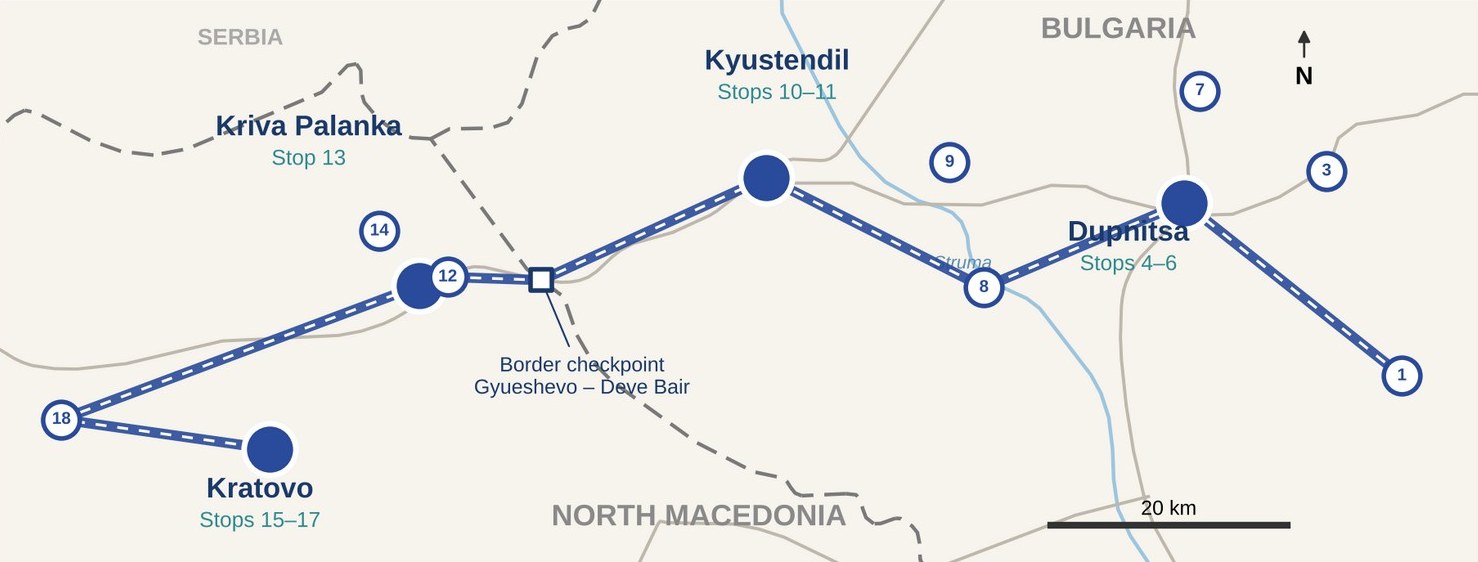
Map of the route “Spirituality and Sanctuaries” with its towns and stops

The route tells the story of the spiritual unity that has connected Kriva Palanka, Kratovo, Kyustendil and Dupnitsa for centuries. The monasteries, churches, hermitages and holy places of this region were centres of literacy, culture and the preservation of spiritual and national identity. Pilgrims, monks, merchants and travellers moved along the same mountain and lowland roads, creating strong ties between the communities on both sides of the border.

The shared root is the tradition of the four spiritual brothers — St John of Rila, St Prohor of Pčinja, St Joachim of Osogovo and St Gabriel of Lesnovo — who lived together in prayer and asceticism in the Lesnovo forest. They then parted: John settled in Rila, Prohor in the valley of the Pčinja, Joachim in the Osogovo Mountains, while Gabriel remained in the Lesnovo forest. Monasteries were later built where they had lived. The route follows this line from the Rila Monastery through Dupnitsa and Kyustendil to the Osogovo Monastery, Gradec and Kratovo.

The historical connection of the four towns derives from their belonging to the common cultural-historical space of the Osogovo–Rila area, historically the ethno-cultural area of Shopluk, where shared Orthodox feasts, religious customs and pilgrimage traditions developed as a common heritage.

The stops

1. Rila Monastery

Founded in the 930s by St John of Rila and his disciples. In 1334–⁠1335 the protosebastos Hrelyo of Strumitsa moved the monastery to its present site and built the Hrelyo Tower. Under Ottoman rule it was a centre of literacy and spiritual self-preservation; during the National Revival schools were opened here, and Neofit Rilski was abbot in 1860–⁠1864. Its present appearance was shaped in the 19th century by masters of the Debar and Samokov schools. In the middle of the courtyard stands the main church of the Nativity of the Theotokos (1837), with over 1,200 scenes and figures painted inside and on its walls, and the relics of St John of Rila. The monastery is a UNESCO World Heritage Site and the eastern pole of the route.

Dupnitsa and Rila · Address: Rila Monastery · Free entry · open every day · about 90 minutes.

2. Resilovo Monastery “Protection of the Theotokos”

The monastery was founded in the 14th century and lies at the foot of Rila. It is known for its distinctive architecture and murals, the work of well-known masters and painters of the past. It has lived through many historical epochs and bears witness to the cultural and religious traditions of the area. Its feast day is 1 October. On the route it follows the Rila Monastery, before the churches of Sapareva Banya and Dupnitsa.

Dupnitsa and Rila · Address: Village of Resilovo · Free entry, with some restrictions · open every day · 30 minutes to 1 hour.

3. Medieval church of St Nicholas, Sapareva Banya

A cross-domed church of the 12th–13th century. According to late-19th-century local sources, an altar stone from the church was sent to the Archaeological Museum in Sofia, where an inscription with the year 1160 was read. It is built of red brick, with courses rendered in alternation (the “recessed brick” technique). According to Nikola Mavrodinov it was a tomb or a chapel next to a larger church, destroyed early in Ottoman rule. It was fully restored in 1937 to a design by architect Aleksandar Rashenov, and studied and restored again in 2016. It is declared an architectural monument of national importance (State Gazette 77/1968).

Dupnitsa and Rila · Address: Germaneya quarter, Sapareva Banya · Free entry, with some restrictions · open every day · about 30 minutes.

4. Church of St Nicholas, Dupnitsa

The oldest church in Dupnitsa, in the Gorna Mahala quarter. It was founded in 1609 by the hieromonk Georgi; the first building was destroyed by the Turks and he rebuilt it in 1623. Georgi was also its first priest and was buried by the north door. It was reconstructed and extended in 1843, plundered and burned in 1852, then rebuilt, and in 1929 the bell tower was raised on the west façade. It is built of river stone, sandstone and brick, and the iconostasis is a brick wall with openings for three tiers of icons. The church stands in the old cemetery park and has been closed since the early 1980s, when the cemetery was moved to the Progona quarter.

Dupnitsa and Rila · Address: 61 Nikolaevska St., Dupnitsa · The church is closed — viewed from outside · 30 minutes to 1 hour.

5. Church “Protection of the Theotokos”, Dupnitsa

One of the oldest churches in the area, built around 1816. It was a cultural and spiritual centre: its courtyard held the sexton’s house, the old school and the community-centre (chitalishte) building of 1874. In the 19th century it was the bishop’s church. A memorial plaque built into the bell tower bears the names of the citizens of Dupnitsa who died in the wars of 1912–⁠1918. The feast day is 1 October, traditionally celebrated in Dupnitsa on 8 September.

Dupnitsa and Rila · Address: 4 Cherkovna St., Dupnitsa · Free entry, with some restrictions · open every day · 30 minutes to 1 hour.

6. Church of St George the Victorious, Dupnitsa

Construction began in 1888; local tradition says a Muslim tekke once stood on the site. The church was consecrated in 1895 by Metropolitan Dositey of Samokov. It is the work of the Hungarian architect József Kerekes. The iconostasis was made by Debar masters of the Filipovi family, and its large icons were painted at the Kyiv-Pechersk Lavra. The church is a national monument. The patron feast is St George’s Day, 6 May.

Dupnitsa and Rila · Address: 1 Bulair St., Dupnitsa · Free entry, with some restrictions · open every day · 30 minutes to 1 hour.

7. Church of St Nicholas, Topolnitsa

The year inscribed in the eastern part of the north wall shows that the church was built in 1856; this is the only evidence, as the chronicle book is lost. Its builder is believed to have been master Milenko of Blateshnitsa near Radomir, whose other churches are close in architecture. Construction and decoration were funded by donations from the villagers of Topolnitsa and from the craft guilds of Dupnitsa. The first painted decoration dates from 1872, most of the murals from 1883. It is a single-nave, three-apse building with an open narthex to the west. The façade is enlivened by arched niches and a painted cornice.

Dupnitsa and Rila · Address: Village of Topolnitsa · By prior arrangement · about 30 minutes.

8. Late-medieval church of St John of Rila, Pastuh

A 16th-century church (chapel) with valuable murals, on the right bank of the Struma, along the historic pilgrimage and trade route between the Kyustendil region and the Rila Monastery. It is a small single-nave, single-apse building with a narthex, about 7.50 × 3.50 m. Its most remarkable feature is the open narthex — the only known example on a single-nave church of this period in the whole of western Bulgaria. The masonry combines river stones, dressed tufa blocks and red bricks. It belongs to the network of sites dedicated to St John of Rila and the other hermits of the “spiritual four”. The feast day is 19 October.

Kyustendil and the Struma Valley · Address: “Dolni manastir” / “Manastircheto” locality, right bank of the Struma, near Pastuh · Access is restricted — view from outside or by arrangement · about 30 minutes.

9. Rock sanctuary “Provirlakata”

A rock sanctuary believed to have originated in the Eneolithic (5th–4th millennium BC) and later used for cult rituals by the Thracian tribe of the Paeonians. The complex consists of monolithic rock blocks, natural arches, carved channels, pits and solar symbols. Its main feature is a narrow, low passage — about 30 cm high — beneath a large rock at the base of the massif. People still believe that crawling through the rock cleft cures infertility and serious illness; the ritual is traditionally performed before sunrise. In a rock niche beside the passage an improvised chapel to the Holy Theotokos has been made, and directly above the sanctuary stands the church of St George the Victorious, built in 1925.

Kyustendil and the Struma Valley · Address: Near the village of Lilyach, about 20 km from Kyustendil · Free entry · open every day · about 45 minutes.

10. Metropolitan church of the Dormition of the Theotokos

Built in 1816 on the site of the medieval church of St Nicholas, as a sunken, three-aisled pseudo-basilica with a timber roof. In 1933 the narthex, a candle workshop and an ossuary were added. Icons by Toma Vishanov and Lazar Zograf of Gorna Studena, and the iconostasis and murals by Ivan Dospevski, make it a monument of Bulgarian Revival art. Its royal doors of the 16th–17th century are identical in workmanship and carving technique to those of St Nicholas in Kratovo (Stop 15), St George in Petralica and the Holy Theotokos in Rankovce (North Macedonia). Metropolitan Ilarion of Lovech and Kyustendil (1872–⁠1884) is buried here. It is a working church.

Kyustendil and the Struma Valley · Address: 37 Demokratsia St., Kyustendil · Free entry · open every day · about 15 minutes.

11. Medieval church of St George, Kolusha

Built in the early 11th century, during the Byzantine conquest of Bulgaria, it is the oldest surviving medieval church in south-western Bulgaria. Murals from the early 12th, 15th–16th and 19th centuries have been uncovered inside. The medieval iconography, by masters of the Thessaloniki school, presents healer saints such as Sts Panteleimon and Hermolaus and Sts Damian and Cosmas. The plan follows the Constantinopolitan model of the cross-domed church, the so-called imperial type. Next to the church is a museum exhibition building with Revival murals and church plate. Legend says Tsar Michael III Shishman, who died after the Battle of Velbazhd in 1330, was buried near the church; historical sources place his grave in Staro Nagoričane.

Kyustendil and the Struma Valley · Address: 1 Kolusha St., Kyustendil · Free entry · Wednesday – Sunday · about 30 minutes.

12. Monastery of St Joachim of Osogovo

The monastery lies at the foot of the Osogovo Mountains and is dedicated to St Joachim of Osogovo, an 11th-century hermit. It was founded in the 12th century, in the reign of the Byzantine emperor Manuel Komnenos (1143–⁠1180), through the efforts of Abbot Theophanes and the local people; it has no ktetor. It is also known as Sarandapor. Construction of the great church began in 1847 on the initiative of Hadži Stefan Beglikčija and it was consecrated in 1851; its builder was Andreja Damjanov, and the frescoes are by Debar school painters, among them Dimitar Andonov Papradishki. Next to it stands a stone post with a turban, a Turkish protective sign. The relics of the saint are kept in the great church; the feast days are 28 and 29 August.

Kriva Palanka and Osogovo · Address: Village of Varovište, about 3 km from Kriva Palanka · Free entry · during the day · about 30 minutes. More about the site.

13. Church of St Demetrius the Great Martyr

The town church was built in 1833; its ktetor was David Jerej and its builder the master Kitan Petrov of Debar. Legend says the Turks permitted a church only as large as an ox hide, but David cut the hide into strips and stretched it over 75 m². The church was built up to the windows, which under Turkish law meant it had to be completed. David was sentenced to death, but told his “sin” before the vali in Prizren, who freed him on condition that he build a channel of running water, the Town Vada, today a footpath with a view of the town. In the churchyard is the grave of Joachim Krčovski, the first Macedonian enlightener. The feast day is 8 November (Mitrovden).

Kriva Palanka and Osogovo · Address: Jane Sandanski St., Kriva Palanka · Free entry · during the day · about 15 minutes.

14. Hermitage of St Joachim of Osogovo

Tradition says that on his way from the Lesnovo forest towards Osogovo, St Joachim chose as his hermitage a cave at the edge of the village of Gradec, entered on one’s knees; a hoof-print of his donkey can still be seen in a rock beside the cave. When a warlike tribe disturbed his peace, he shot an arrow into the sky, saying he would continue his ascetic life where it fell. It fell far to the east, at Babin Dol, where his monastery was later built. Today the hermitage is a landscaped destination with a stage. Believers and the people of Kriva Palanka gather here on the feast of St Simeon the Stylite, 14 September, the village feast of Gradec. Nearby is the 19th-century church of St Nicholas.

Kriva Palanka and Osogovo · Address: Village of Gradec, 7 km north of Kriva Palanka · Free entry · during the day · about 30 minutes.

15. Church of St Nicholas the Wonderworker

The church stands on the right bank of the Kratovska River, on the east side of the Carina quarter. It is first mentioned in 1666 as the cathedral church of Kratovo: an inscription of that year in a Gospel donated to the church attests that it was once the cathedral of the bishops of Kratovo. It was destroyed and rebuilt several times — partly in 1822 and completely in 1848 — and consecrated in 1854. It is built of dressed stone and roofed with stone slabs brought from Mount Lisec. Its royal doors, thought to date from the late 16th or early 17th century, are identical in technique to those in the Dormition church in Kyustendil (Stop 10).

Kratovo · Address: Braća Miladinovi St. b.b., Carina quarter, Kratovo · Free entry · during the day · about 15 minutes.

16. Church of St John the Forerunner

The church belongs to the works of the building crew of Andreja Damjanov. The inscription carved in the stone lintel of the west entrance records that it was renewed “through the effort and expense of all Christians” in 1836. According to older Kratovo residents, it was burned during the Karpoš Uprising (1689): the walls remained but the roof burned completely. The gilded walnut iconostasis is one of the first works of Petre Filipovski – Garkata, and the icons are by Dimitar Andonov Papradishki and the Samokov painters Dimitar Hristov and his son Zaharij Dospevski. It is 18 m long, 10 m wide and 8 m high. Locals believe it holds three healing icons; the life-size icon of St George of Kratovo is by Zaharij Dospevski.

Kratovo · Address: Josif Daskalov St. b.b., Ribarsko quarter, Kratovo · Free entry · during the day · about 15 minutes.

17. Church of St George of Kratovo

The church was built between 10 August 1921 and 1925 in honour of the Macedonian new martyr St George of Kratovo, and consecrated on 28 August 1925. George was born in 1497 into a Kratovo family and learned the goldsmith’s craft. Refusing to change his faith, he was burned at the stake in Sofia on 24 February 1515, and was canonised at the Council of Moscow in 1549. His cult is venerated across almost the whole Balkans. In 2002 the Kratovo municipal council proclaimed him patron of the town. The iconostasis icons and frescoes were made in 1925 by Dimitar Andonov Papradishki and Gjorgji Zografski. The feast, 24 February, is also the Town Festival of Kratovo.

Kratovo · By prior arrangement · about 20 minutes.

18. Rotunda church at Konjuh

A rare early-Christian martyrium of circular form, dating from the 6th century, at the archaeological site of Golemo Gradište. It was discovered by chance by villagers in 1919 and recorded by Nikola Vulić. According to Vulić it was the central church of a large ancient town, probably Trnopara. The church is centrally planned with a dome: rectangular outside, with a circular central space surrounded by a horseshoe-shaped ambulatory on massive masonry piers. It is 23 m long. The foundations of the bishop’s throne and parts of the synthronon survive, as do remains of the altar screen on six columns, and the presbytery floor forms a cross in opus sectile. The town covered 17 hectares. Legend speaks of a secret room beneath the Kriva Reka.

Kratovo · Address: Golemo Gradište archaeological site, village of Konjuh · Free entry · during the day · about 20 minutes.