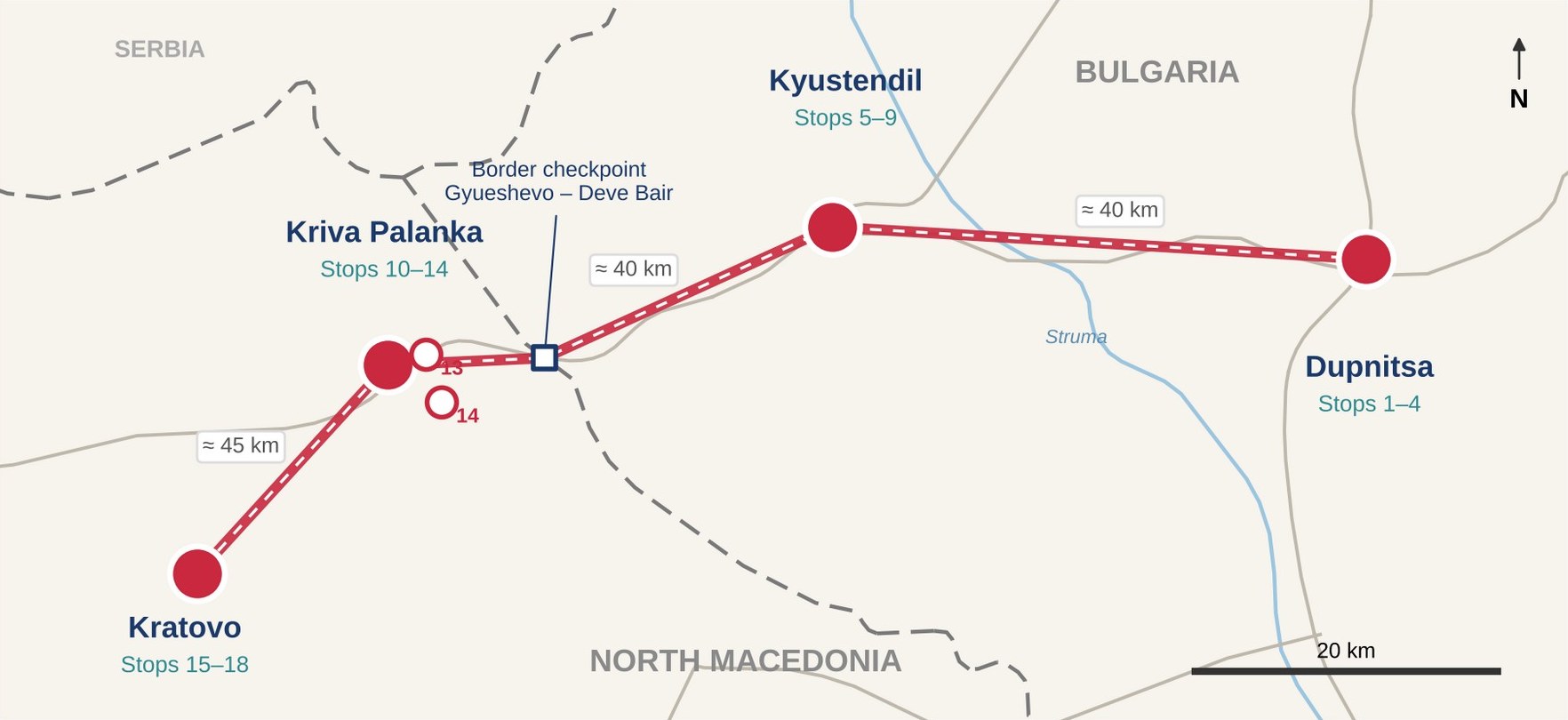
About the route

Map of the route “The Path of Craftsmen, Capital and Ideas” with its towns and stops

The route tells the story of the cross-border area of Kriva Palanka, Kratovo, Kyustendil and Dupnitsa as a living territory where people, knowledge, crafts and trade have for centuries crossed political and administrative borders. The rich mineral resources of Kratovo and the Osogovo region created strong traditions of mining, metallurgy and craftsmanship, while the trade routes linking Macedonia and Bulgaria carried not only goods and capital but also ideas, artistic influences, Enlightenment values and cultural practices. Places of learning took shape in the town bazaars, monastery complexes and masters’ workshops.

Old roads across the Osogovo Mountains, through the Egri Dere gorge, linked the towns on both sides of the border. Building techniques, architectural solutions and craft knowledge travelled along them and are still recognisable in the similar stone bridges, sacred buildings, inns and traditional town houses. Building crews from the Kriva Palanka area worked on buildings in Sofia such as the Audit Chamber, the Central Mineral Baths and the “Slavyanska Beseda” Hotel, and on the Sofia Theatre. The mines of Kratovo, Kriva Palanka and the Kyustendil region were part of a wider economic system, and the first written mention of Kratovo is in Dubrovnik trade contracts of the 14th century. In the 18th and 19th centuries the same routes carried liturgical books, manuscripts, textbooks and ideas of national revival.

The route does not focus only on individual historic sites: it shows how a cross-border region was formed through the work, knowledge and enterprise of its people. The stops are grouped along three paths: of Craftsmen, of Capital and of Ideas.

The stops

1. Historical Museum – Dupnitsa

Museum work in the town began in 1911 with the archaeological society “Tsarichina”, whose collection later passed to the community centre (chitalishte). The “Stanke Dimitrov – Marek” house-museum opened in 1954 and the “Vasil Demirevski – Zhelyo” house-museum in 1984. The present museum was established on 8 May 1992 by Decision No. 93 of the Dupnitsa Municipal Council, with departments of Archaeology, Ethnography, History of Bulgaria 15th–19th c., and Modern and Contemporary History. Its holdings include more than 8,400 museum items. The building, the former Youth House, is known as the first of its kind constructed with a cable-stayed (“suspended”) structure.

Dupnitsa · Address: 33 Hristo Botev St · Free entry · Mon–Fri 10:00–⁠18:00, Sat 10:00–⁠16:00 · 30 minutes – 1 hour.

2. “Dzhamiyata” Exhibition Hall

In the town centre stands the only one of the thirteen mosques that existed in Dupnitsa before the Liberation. Most researchers date it to the late 15th – early 16th century. It is an almost square building of 300 m² with a large columned portico, a three-bay arcade on pointed arches, and a smaller türbe (tomb) at the corner. Inside are a mihrab niche with stalactite (muqarnas) decoration and a plastered brick dome; the minaret has been destroyed. Granite blocks, probably Christian gravestones, are built in to the right of the portal, one carved with a Golgotha symbol and the inscription IC XC / NHKA. Declared a cultural monument in 1968, it is now an exhibition hall.

Dupnitsa · Address: 19 Ivan Vazov St · Free entry, with restrictions · Mon–Fri 10:00–⁠18:00, Sat 10:00–⁠16:00 · 30 minutes.

3. District House (Okoliyska kashta)

The gallery occupies the building known as the District House. It was first a toll house (barierniza) and later a konak (government house), and was declared a monument of culture and architecture in 1972. In 1979 the National Institute for Cultural Monuments in Sofia prepared a project for its restoration and adaptation, carried out in 1981–⁠1986. Since then the building has hosted exhibitions, book presentations, poetry evenings and more. Prominent artists from the region and the country have shown paintings, watercolours, graphics, small sculpture and sculpture at the “Okoliyska kashta” gallery, and the National History Museum has also presented exhibitions here.

Dupnitsa · Address: 21 Ivan Vazov St · Free entry, with restrictions · guide on request · Mon–Fri 10:00–⁠18:00, Sat 10:00–⁠16:00 · 30 minutes.

5a. “Dimitar Peshev” House-Museum

The house-museum is a joint project of the Municipality of Kyustendil and the Union of Bulgarian Jews in Israel, carried out between August 2002 and March 2003. The permanent exhibition of original objects, photographs and facsimiles tells of the events of March 1943 and of the merits of Dimitar Peshev and his fellow townsmen from Kyustendil — Asen Suichmezov, Vladimir Kurtev, Ivan Momchilov and Petar Mihalev — in the rescue of the Jews in Bulgaria. The personal belongings were donated by the descendants of the rescuers, and the study has been reconstructed with objects donated by the National Assembly. On this route the house marks the moment when “the Path of Ideas” reaches its moral summit: the defence of human life above ideological dictate.

Kyustendil · Address: 11 Tsar Simeon I St · Restricted access · Wednesday – Sunday · 30 minutes.

5b. Art Gallery “Vladimir Dimitrov – The Master”

The gallery bears the name of the most significant Bulgarian painter of world renown. It was founded in 1959 and in 1972 moved into a building constructed especially for it. It holds the core and largest collection of works by Vladimir Dimitrov – The Master, arranged as a permanent exhibition, and periodically shows works by other Kyustendil artists such as Stoyan Venev, Kiril Tsonev, Morits Bentsionov, Nikola Mirchev and Asen Vasiliev. Every October it opens its halls to the final stage of the International Plein Air “St Luke”. The Master captured the interweaving of the spirit of the peasant, the land, nature and the age-old folk traditions that unites Osogovo and the surrounding valleys.

Kyustendil · Address: 20 Patriarch Evtimiy St · Restricted access · every day · 30 minutes.

5c. Dervish Bath

The Dervish Bath is a well-preserved Ottoman monument in the centre of the modern town, built in 1566, the last year of the reign of Suleiman the Magnificent. It was part of an architectural ensemble at the centre of the former Dervish quarter, together with the Kaya Bey Mosque, the Dervish fountain and the tekke (lodge) of the order of wandering Sufi dervishes. It is declared a monument of culture within the National Architectural and Archaeological Reserve “Pautalia – Velbazhd – Kyustendil”. The healing thermal springs attracted merchants, travellers and caravans, and the building shows the spread of domed structures, hydraulic systems and heating with mineral water carried by itinerant builders’ guilds.

Kyustendil · Address: 2 Tsar Ivan Shishman St · Exterior only · every day · 10 minutes.

6. Majorska House (The Major’s House)

The Majorska House dates from 1870 and was the home of Major Yosif Angelov (1857–⁠1913). It stands out with a richly decorated façade facing the courtyard; the entrance is a niche framed by two granite columns and an arch. It is a two-storey symmetrical National Revival dwelling with a semi-sunken ground floor and an upper floor with a raised kyoshk, separated by a low wooden balustrade. In 1969 it was restored by the National Institute for Monuments of Culture and for a long time housed the ethnographic exhibition of the Regional Historical Museum. At the end of the 1990s it was restituted to the heirs. Today part of the property is the restaurant “Mayorska kashta”.

Kyustendil · Address: 83 Tsar Osvoboditel St · Exterior only · every day · 15 minutes.

7a. Granitski House

The house belonged to Hristo Granitski, a wealthy Kyustendil merchant. Judging by its plan and composition, the organisation of its façade and its overall architectural style, it dates from the middle of the 19th century. The ground-floor core contains a shop (dyukyan) and the upper floor has a decorative ceiling. A courtyard opens between the Granitski and Lekarska Houses, which together form an ensemble best seen from above. The house is not open to visitors and is viewed from outside.

Kyustendil · Address: 11 Targovska St · Not open to visitors · 10 minutes.

7b. Lekarska House (The Doctor’s House)

The house belonged to Ivancho Hristov Hekim and is known among the people of Kyustendil as the Lekarska (Doctor’s) House. It was built in the 1850s of stone, timber and grey-blue lime-and-straw plaster. It has a stone ground floor with a double-leaf street door, a spitseriya (pharmacy) facing the street, and an upper floor with strongly projecting bay windows above the entrance. The south-western ground-floor room is heated by a dzhamal (built-in stove). The ceilings of the kyoshk and of the upper rooms are decorated with stylised geometric motifs — the sun, the tree of life, a vine-trellis ceiling — and, in the corners, triangular pendentives with images of double-headed eagles.

Kyustendil · Address: 13 Targovska St · By prior arrangement · during the day · 20 minutes.

8. Emfiedzhieva House

The house was built in 1874 and belonged to Hristo Lazov the Coppersmith (Kazandzhiyata), master of the guild association, who had settled from Shtip. His heir was his son-in-law Nikola Emfiedzhiev, who traded in emfie (snuff), from which the house takes its name. It is a one-storey house on a U-shaped plan with semi-sunken cellars and courtyards enclosed by massive stone walls, with a glazed vestibule, a large guest salon, a small salon for afternoon visits, a bedroom, a living room and a kitchen with dining room. During the Russo-Turkish war two of its rooms housed the headquarters of the 4th Kharkov Uhlan Regiment. Today it is a museum with the exhibition “Urban life and culture”; a monument of culture of local significance since 1974.

Kyustendil · Address: 24a Gorotsvetna St., Lozenets (Baglak) quarter · Free entry · Tuesday – Saturday · 40 minutes. More about the site.

9. Medieval church of St George, Kolusha

The church stands in the south-western part of Kyustendil, in the Kolusha quarter (the medieval village of Kolasia). It was built at the beginning of the 11th century and is the oldest surviving medieval church in South-Western Bulgaria. Its interior has revealed wall paintings from the early 12th century, the 15th–16th centuries and the 19th century. It is almost square in plan (10 × 8.70 m), a cross-in-square church of the so-called imperial type, in which every other course of bricks is hidden under the mortar on the outside. Next to it is a museum building displaying National Revival wall paintings and church plate. With the Rila Monastery and the Osogovo Monastery, the church preserves the shared faith and cultural identity of both sides of the border.

Kyustendil · Address: 1 Kolusha St · Free entry · Wednesday – Sunday · 30 minutes.

10. Old Bazaar of Kriva Palanka

The old town bazaar reached its peak during the National Revival in the 19th century, when it counted some 250 shops. The most common crafts were those of the aba (wool cloth) makers, tailors, saddlers, shoemakers, potters, gunsmiths, farriers, blacksmiths and ironmongers, alongside inns and taverns, barbers, halva makers, furriers, dyers and bakeries producing the Kriva Palanka “simit”. The best-known merchants were Hadži Stefan Mladenov and Hadži Madžo, with trade links to Constantinople, Thessaloniki, Sofia and Leipzig. Today only a few tailoring, barber and shoemaking shops survive, among them the barber shops of master Noće and master Martin Karadak. The layout, a narrow street with buildings joined in continuous blocks, still conveys the past of this trade-and-craft complex.

Kriva Palanka · Address: St Joachim of Osogovo St · Free access · during the day · 30 minutes.

11. City Museum Kriva Palanka

The City Museum, founded in 2006, is housed in one of the oldest buildings in the municipality (1926/27). Its collection counts over 3,500 exhibits covering ethnology, archaeology, history, art history, numismatics and the technical culture of the Kriva Palanka region. The ethnological display of 2011 was fully reconceived in 2016–⁠2018, with a rural part and an old-town part depicting town life from the late 19th to the mid-20th century; the historical display dates from 2006 and the archaeological one from 2013. The museum has an art gallery, a souvenir shop and a library, and offers audio tours in several foreign languages. In the absence of visible buildings from the Revival period, it fills the gap with original objects and replicas.

Kriva Palanka · Address: 134 St Joachim of Osogovo St · By prior arrangement · 08:00 – 16:00 · 40 minutes.

12. Town church of St Demetrius the Great Martyr

The church was built in 1833 through the efforts of the town notables and hajjis, with David Jerej, son of St Joachim Krčovski, as ktetor. The same year a school was built in the churchyard, the foundation of the first public school; its first teacher was Ivan Petrov of Kratovo. In 1869/70 the first girls’ school, “Majka”, opened. Before the church, a cell school existed in the Engerova House, documented from 1817, where Joachim Krčovski taught. The church-school community, acting as a people’s parliament, met here. The churchyard holds the grave of Joachim Krčovski, the first Macedonian enlightener. Above the church runs the walking trail “Stara vada”, linked to the legend of the church built within “a buffalo hide”.

Kriva Palanka · Address: 23 Jane Sandanski St · Free entry · during the day, guide on request · 30 minutes.

13. Monastery of St Joachim of Osogovo

Founded in the 12th century, the monastery is one of the most important Orthodox spiritual and cultural centres of the region. For centuries it was a centre of literacy, book copying and education, and an important stop for travellers, merchants and pilgrims from both sides of today’s border. After his ordination Joachim Krčovski, one of the most important Macedonian enlighteners of the Revival, taught at the cell school of the monastery, where he became a monk after his wife’s death. The printing of his five works in the living vernacular was supported by the notables of Kriva Palanka. He was canonised in 2022, and the great monastery church holds his sarcophagus. The feast of the monastery is on 29 August.

Kriva Palanka · Address: Village of Varovište · Free entry · during the day · 30 minutes. More about the site.

14. Fulling mill (valavica) in Stanci

In the past the village of Stanci, about 7 km from Kriva Palanka, had several fulling mills and water mills. Today only one fulling mill remains, more than a century old and one of the last in the country. Woollen blankets (jambolii), rugs and handwoven fabrics are fulled naturally, by water falling freely from a beech chute into a trough where it swirls the textiles; the mill race is fed by the Kozja River. The family craft is continued by Tome Jakimovski, who inherited it from his grandfather Blagoja and father Vladimir, with his wife Jasminka and younger son Antonio. This is a “wet” fulling mill; “dry” mills once existed too, used only for woollen cloth (klašni). Next to it are a water mill and a summer house for guests.

Kriva Palanka · Address: Village of Stanci · Free entry · during the day, guide on request · 30 minutes.

16. Museum of the City of Kratovo

The museum was founded in 1993 and is housed in the legally protected Saraj House, a building of the second half of the 19th century in the town centre on the left bank of the Kratovska (Tabačka) River; beneath it lies the old Turkish prison. It has ethnological, archaeological, historical and conservation departments, over 1,000 objects and coins from the former Kratovo mint. Since 2005 it has managed the displays in the Clock Tower (Saat kula), with the permanent display “Kratovo through the Centuries”, and in Simić Tower, on the Karpoš Uprising of 1689. It also manages the “Stone Dolls” site at the village of Kuklica. The building itself has a central chardak ending in a doksat over the river.

Kratovo · Address: St Gjorgji Kratovski St. b.b. (4 Gjuro Salaj St.) · By prior arrangement · 08:00 – 16:00 · 30 minutes.

17. House of Josif Daskalov

The birthplace of Josif Daskalov, teacher, revolutionary and public figure, is a typical old town house in the recognisable Kratovo style. Daskalov was born in Kratovo in 1868, finished the Pedagogical School in Kyustendil and taught in Kratovo, Skopje and elsewhere. In 1894 he joined the Macedonian revolutionary organisation (TMORO), sworn in by Goce Delčev, who appointed him head of the Kratovo revolutionary region. Arrested in 1897, he threw himself off Radin Bridge, pulling the kaymakam with him. Sentenced to six years, he was imprisoned on Rhodes, amnestied in 1902, and poisoned in 1909. The house was bought and restored by the Macedonian Orthodox Church through the Diocese of Kumanovo and Osogovo; its exterior is fully preserved.

Kratovo · Address: 59 Josif Daskalov St · By prior arrangement · during the day · 30 minutes.

18. Kratovo towers and bridges

The medieval towers are among the most recognisable symbols of Kratovo. They were built in a defensive semicircle on the order of the dignitary Konstantin Damjanov and predate the Ottoman period; their present appearance results from 20th-century works. Of the original 13 towers only 6 remain, each named after its last owner. The Clock Tower (Saat kula) was probably built c. 1372; Simić Tower is the tallest, with 69 stone steps inside the wall; Zlatkova Tower dates from 1365 and Krsteva Tower from c. 1371/72. Stone bridges across the Kratovska and Manceva rivers complete the medieval atmosphere: Čaršiski Bridge (1804) is almost 12 m high and features on the municipal coat of arms, and Radin Bridge (1833) carries the legend of Rada. It is also where Josif Daskalov leapt.

Kratovo · Address: Old town core · Bridges – free access; towers – by prior arrangement · towers 08:00 – 16:00 · 40 minutes.

More stops

The Clock Tower is an 18th-century defensive tower adapted as a clock tower, once rising above the whole surroundings. After the Liberation it was rebuilt and fitted with a clock mechanism, and for many years the people of Dupnitsa relied on it to mark the beginning and end of the working day. The tower is square, built of river stone with lime-sand mortar, with a loophole on each side. A timber storey for the clock mechanism sits above stone walls up to 1 m thick at the base. The four-sided pyramidal pavilion above the roof holds a small bell inscribed “Vienna 1782”. An eagle with spread wings once stood before the bell, but was shot down by hunters in 1907.

Dupnitsa · Address: 2 Kokiche St · Exterior only · at any time · 30 minutes.

The bazaar is the trade, craft, social and cultural heart of Kratovo. It is declared cultural heritage of North Macedonia and forms a distinct monument ensemble on the left bank of the Kratovska River. In 2014 the Municipality of Kratovo and the Ministry of Culture restored five shops here. The most shops, about 350, existed in the 17th century: smiths, kujundžii (silversmiths), tinsmiths, tanners, butchers and goldsmiths, who had their own quarter. This is linked to the lead, silver, gold and copper mines for which Kratovo is famous; under the Ottoman Empire the town also had a smelter and a mint. With the closure of the mines people began to emigrate, most of all to newly liberated Bulgaria. Of the 86 shops recorded in 1943, 49 remain today.

Kratovo · Address: Pitu Guli St. and Partizanska St · Free access · 24 hours · 30 minutes.