About the route

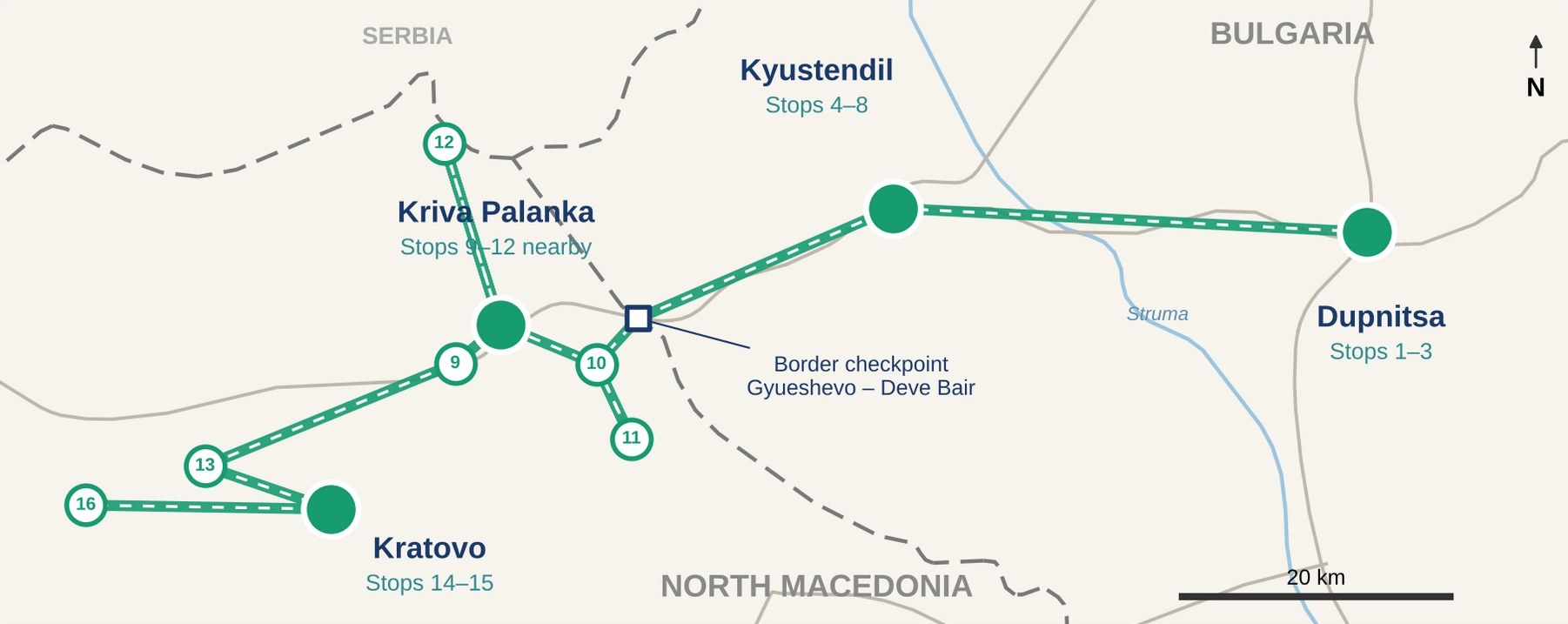
Map of the route “Living Traditions” with its towns and stops

“Living Traditions” tells the story of the communities of the Osogovo–Kyustendil region, where the centuries are preserved not only in stone and monuments but in the customs, feasts, songs and rituals still passed down from generation to generation. The border between today’s North Macedonia and Bulgaria was never a full cultural divide: people shared a similar way of life, farming cycles, beliefs and festive practices. The route connects the living traditions of Kriva Palanka and Kratovo with those of Kyustendil and Dupnitsa, revealing a shared cultural code built around family, community and respect for the cycles of nature and the spirit.

In Dupnitsa, the route follows the town’s living traditions: the Dupnitsa embroidery, which survives intact only in old photographs and in needlework remade in the early 20th century into panels and tablecloths; the Dupnitsa costume, richly decorated from the beaded headdress to the hem, which disappeared at the end of the 19th century — only two such shirts survive, one at the National Ethnographic Museum in Sofia and the other at the Metropolitan Museum of Art in New York; the legendary “Dupnitsa grill”; and the traditional gathering on the Friday after Easter, kept alive to this day.

What sets the route apart is that intangible heritage is presented not as the past but as living practice — customs, wedding and festive rituals, folk songs, traditional cuisine, local events and crafts. The bond between the four towns rests on the shared cultural space of Osogovo: trade routes, seasonal movements, markets, religious feasts and kinship. Old roads across the Osogovo Mountains (through the Egri Dere gorge) linked the towns and carried not only merchants and craftsmen but also books, manuscripts and the ideas of national revival. The border has not interrupted cultural continuity.

The stops

1. “Umni petak” gathering

Only in Dupnitsa is the Friday after Easter called “Umni petak” (Wise Friday). It is the town’s annual gathering, once held together with a fair, which local historians date to long before the Liberation. From early morning people from the villages of the whole district came to the courtyard of the church of St George, in the dress of Razmetanitsa, Gorno pole and Dolno pole, to look at one another, get acquainted and dance the horo to gaidas, kemaneta, clarinets and drums. Stalls along the edge sold simits, sweets, toys and kebapcheta. This is how Aleksandar Visokomogilski (b. 1904) recalls it in the notes of the teacher Vladimir Nikolov. The gathering was mainly a village one; on Saturday came the town gathering.

Dupnitsa · Address: Bulair St., Pazarna St., the area around the church of St George, Minchov Square · Free access · open public space, the gathering runs all day · 30 minutes – 1 hour.

2. The Dupnitsa grill — the “Dupnitsa kebapche”

A characteristic local phenomenon is the “Dupnitsa grill”, or “Dupnitsa kebapche”, which sadly is no longer offered in the town. Until the 1940s it was made in the town’s grill houses and ordered specially by the royal palace in Sofia. When Tsar Simeon II visited Dupnitsa on 5 June 1996, he asked for the recipe of the kebapcheta he remembered from childhood. Nikola Lazov, heir of the grill master Mihal Lazov, handed over the family recipe: lamb chopped to mince on a wooden board, salted, left for 24 hours in the cold, mixed with onion and shaped into finger-sized kebapcheta on a charcoal grill. They reached the palace still warm, wrapped in a hot lamb’s stomach.

Dupnitsa · Address: “Svoboda 1” Square · Free access · open public space · 30 minutes – 1 hour.

3. Dupnitsa embroidery (shevitsa)

Dupnitsa embroidery has a vivid style and an artistic language of its own. Its ornament carries ancient ideas of the order of the world and the cycle of life and the compositions show the Tree of Life from root to crown,. The stitch is a fine slanting one over a pre-drawn design, and the colours run from bright orange through scarlet to purple. Until the end of the 19th century the women of the Dupnitsa area embroidered their own shirts; the old costumes then stayed in chests, and the embroideries entered town homes as tablecloths and cushions. In the museum’s project “Let’s Embroider like Grandma!” (2018) over 30 women learned the forgotten craft; two still embroider and have made copies of the Dupnitsa costume.

Dupnitsa · Address: “Svoboda 1” Square (Historical Museum – Dupnitsa collection) · Museum collection · 30 minutes – 1 hour.

5. “Kyustendil Spring” — traditional feast of the town (21 March)

In 1954, 21 March was officially declared the Day of Spring, and from 1967 all events were brought together in the cultural programme “Kyustendil Spring”. A two-round competition selects the maiden “Kyustendil Spring”; the previous one hands over the crown, a golden key that unlocks the living forces of spring, and a golden apple — a symbol of the fertility of the Kyustendil land. On the day, the people of Kyustendil welcome spring at the highest point of Hisarlaka Hill, where, as they believe, it arrives first. The feast goes back to pagan cults of the sun and of life, linked to Attis and Cybele, and to the town’s mineral springs. It ends with a popular celebration.

Kyustendil · Address: Velbazhd Square and Hisarlaka Hill · Free access · during the event · 5 hours.

6. Cherry Festival

The Cherry Festival is the best-known and most visited summer event in Kyustendil, linked to the region’s fame as the “Orchard of Bulgaria”. In the Kyustendil region the cherry is seen as a symbol of spring awakening, new beginnings and the richness of the land. The festival draws inspiration from the First National Fruit-Growing Exhibition of 1896; in its present three-day format it has been held since 2008. The programme includes art studios and entertaining workshops, competitive games with cherries, an exhibition of cherries and cherry products, a presentation of varieties by the Agricultural Institute – Kyustendil, a cherry bazaar and festive concerts. It takes place at a weekend in the second half of June.

Kyustendil · Address: Velbazhd Square · Free access · during the event · 3 hours.

7. Cultural Forum “Panagia – Elevation of the Bread”

The Cultural Forum is dedicated to the Dormition of the Most Holy Theotokos (Golyama Bogoroditsa) and to the meaning of bread in the Bulgarian tradition. It has been held every year since 2008 and unfolds over two days. On 14 August master bread-makers knead the Theotokos bread in a village or in the yard of a church or monastery, while girls and women in folk costume reap ears of wheat, sing ritual songs and knead the dough with “silent water” and holy water. On 15 August an exhibition shows ritual loaves baked by community centres and housewives from the region, decorated with relief symbols. Priests perform a water-blessing and the ritual “Elevation of the Bread” (Panagia), after which the blessed bread is broken and shared.

Kyustendil · Address: The park opposite the church of the Dormition of the Theotokos · Free access · during the event · 2 hours.

8. Feast of Fertility

The feast lasts three days at the end of September. Individual participants, community centres and craftspeople set up stalls with fruit, vegetables, dishes and their own products, and a competitive programme with music accompanies them. Prizes go to the most beautiful and artistically arranged stall and to the largest apple, and culinary contests judge the tastiest home-made winter preserves, jams and baked goods. The Agricultural Institute presents dozens of promising and traditional apple varieties grown in the region. Visitors can buy fresh local produce and craft products. The feast is a legacy of the first fruit-growing exhibition in the country, held in Kyustendil in 1896. In its present form it has been organised every year since 2008 by the Municipality of Kyustendil in partnership with the institute.

Kyustendil · Address: Velbazhd Square · Free access · during the event · 3 hours.

9. Brides’ veneration of St Theodore Tiron – “Todorica”

The event, held at the church of the same name in the village of Konopnica, is one of the most authentic living traditions of the Kriva Palanka region. On Todorica, the feast of St Theodore Tiron, young brides together with their mothers-in-law, in traditional costume, take part in a festive procession and bow before the church — a rite linked to family, marriage and blessings for fertility. It is accompanied by folk songs and dances, exhibitions of costumes and presentations of local customs. It is organised by the association “Patnik” and the Municipality of Kriva Palanka. The church dates from the 19th centurywith a rare “circular” plan. The frescoes are by Avram Dičov, son of Dičo Zograf of the Debar school, and the church has 47 icons.

Kriva Palanka and Osogovo · Address: Church of St Theodore Tiron, village of Konopnica · Free access · during the day · 1 hour.

10. The legend of Kalina — Kalin Kamen

The legend of the beautiful maiden Kalina is one of the best-known folk tales of Kriva Palanka and the Osogovo Mountains. In Ottoman times a girl named Kalina, famed for her beauty, lived in the region; a Turkish aga abducted her and locked her in his saraj, intending to make her his wife. Kalina escaped and, after a long journey, reached the high rock below Carev Vrv. Rather than surrender, she threw herself from the rock. In her honour the people named the rock Kalin Kamen, and the legend is still told as a symbol of courage, dignity and defiance. The rock from which Kalina is said to have leapt still stands, and Kalin Kamen is one of the best-known tourist sites of Osogovo.

Kriva Palanka and Osogovo · Address: Kalin Kamen locality, Osogovo Mountains · Free access · during the day · 1 hour.

11. The legend of Carev Vrv

Since ancient times royal armies passed and rested along the highest peaks of Osogovo; the old road ran over the steep slopes by today’s Carev Vrv from Roman times. At 2,085 m it is the second-highest peak of Osogovo. Tradition says the Byzantine emperor Constantine built a fountain here, hence the name “the Tsar’s Peak”. Under the Ottoman Empire it was called Sultan Tepe, because Sultan Murad I spent a night here during his campaigns in the Balkans. On the summit are the remains of a stone border post from the time of the Kingdom of Yugoslavia, and at the foot of the peak rises the Kriva Reka. The fountain and the old border post can still be seen.

Kriva Palanka and Osogovo · Address: Carev Vrv peak, Osogovo Mountains · Free access · during the day · 1 hour.

12. Lazarus customs (Lazarki) in the village of Luke

According to ethnomusicological research, in north-eastern Macedonia, including the Kriva Palanka area, small groups still organise Lazarus processions on Lazarus Saturday. Girls visit the households with song and dance, and sometimes go through the fields. Specific to the area are the “male Lazar” (a girl with an umbrella) and the “female Lazar” (in a flowered headscarf), who walk in front, followed by singing groups of three girls. The village of Luke is most often mentioned as a place where the custom is documented as living: there is the MRTV film “Lazarici” (2000), and the folk ensemble “8-mi Oktomvri” of Kriva Palanka regularly performs the Lazarus songs of Luke. The custom is part of an old spring ritual of singing and processions, linked to joy, fertility and girls’ passage to maturity.

Kriva Palanka and Osogovo · Address: Village of Luke · Free access · during the day · 1 hour.

13. “Stone Dolls” (Kameni kukli)

Eight kilometres from Kratovo lies the “Stone Dolls” site, linked to the legend of the “Petrified Wedding”. Long ago a young man of Kuklica, a good mason but a great liar and lover, was loved by two girls. One was more beautiful but poor, the other richer. He chose the richer one and set the wedding. On the wedding day, hearing the gaidas and drums, the poor girl cursed the couple and all the guests to turn to stone — and at the moment the newlyweds kissed, the curse came true. The couple remained embraced and the guests seemed to go on celebrating, so the place is also called the “Merry Wedding”. Scientifically, the pillars come from long erosion of volcanic rocks; the site is a protected natural rarity.

Kratovo · Address: Village of Kuklica (8 km from Kratovo) · By prior arrangement · open site, groups by prior arrangement · 30 minutes.

14. The legend of the five pines and two chestnuts

In the 13th–14th centuries, when the great mining boom began in the Kratovo area, Saxon miners, known as Sasi or Šlezi, settled in the town with their families. According to tradition, the first seven Saxon families each planted a tree as a symbol of putting down roots and prosperity — five pines and two chestnuts. The pines were planted where the City Park is today. Of the five, two survive: one is said to have caught fire in the 1920s and burned for ten days, and another was cut down around 1948–⁠1951. The two remaining pines grow more than ten metres apart, yet their branches are intertwined high in the air, which people read as a symbol of love and connection. Said to date from the 14th century, they are “living monuments” of Kratovo.

Kratovo · Address: City Park · Free access · open public park · 30 minutes.

More stops

The National Masquerade Festival “Dzhamala” in Kyustendil brings together thousands of kukeri, survakari, babugeri, bear-leaders and dzhamalari from all over Bulgaria. In the local tradition the custom is known as “Dzhamalari” and is performed during the “unclean days”, between Christmas or St Basil’s Day and St John’s Day. The band is led by a bagpiper; the key figures are the old woman, the old man, the groom with a horse, and the deditsi in wooden masks, with humps and heavy bells at the belt. From house to house they dance the “dzhamalarka” horo around a sieve of grain, wishing health, fertility and abundance. The festival is organised every February by the Municipality of Kyustendil on Velbazhd Square and Demokratsiya Blvd; a jury judges the authenticity of costumes and rituals.

Kyustendil · Address: Velbazhd Square · Free access · during the event · 2 hours.

In the time of the feudal ruler Konstantin Dejanov and his wife, the empress Elena, Kratovo had the Queen’s Tower near the Sarajski Bridge, also known as Šuta Tower. Their daughter Sara was beautiful, clever and playful. When the Turks conquered Kratovo, they could not take the tower for long; they shot burning arrows and its upper part caught fire. The family decided to flee through the underground passages. Before escaping, Sara threw the key of the tower down to the Turks, and while they searched for it she got away through the tunnels with bags of gold coins. Hence the Kratovo saying: “The Turks found neither money nor Sara.” Remains of the tower can be seen on the left side of Goce Delčev Street; it stood until 1914, when it was demolished.

Kratovo · Address: Goce Delčev St., near Sarajski Bridge · Free access · during the day · 20 minutes.

Twenty-eight kilometres west of Kratovo, in the village of Konjuh, near the rotunda and the church of St John the Baptist, lies Gađan Kamen, a witness of an ancient legend. As told by Stoe Matrapaz, who heard it from his grandfather, it was here that the Macedonians chose their king, the wise Makedon. Before his coronation the king called cooks, barbers and musicians to compete for the honour of serving at his court. But who would guard the king? Makedon set contests of jumping, diving, catching a live fish and a snake, climbing, spear-throwing and descending into tunnels. Three remained; one even walked through fire. At last the king said: “Whoever brings me a live fox shall guard me.” Marks on the stone slab are, the villagers say, proof of the event.

Kratovo · Address: Village of Konjuh, near the rotunda and the church of St John the Baptist · Free access · during the day · 1 hour.