
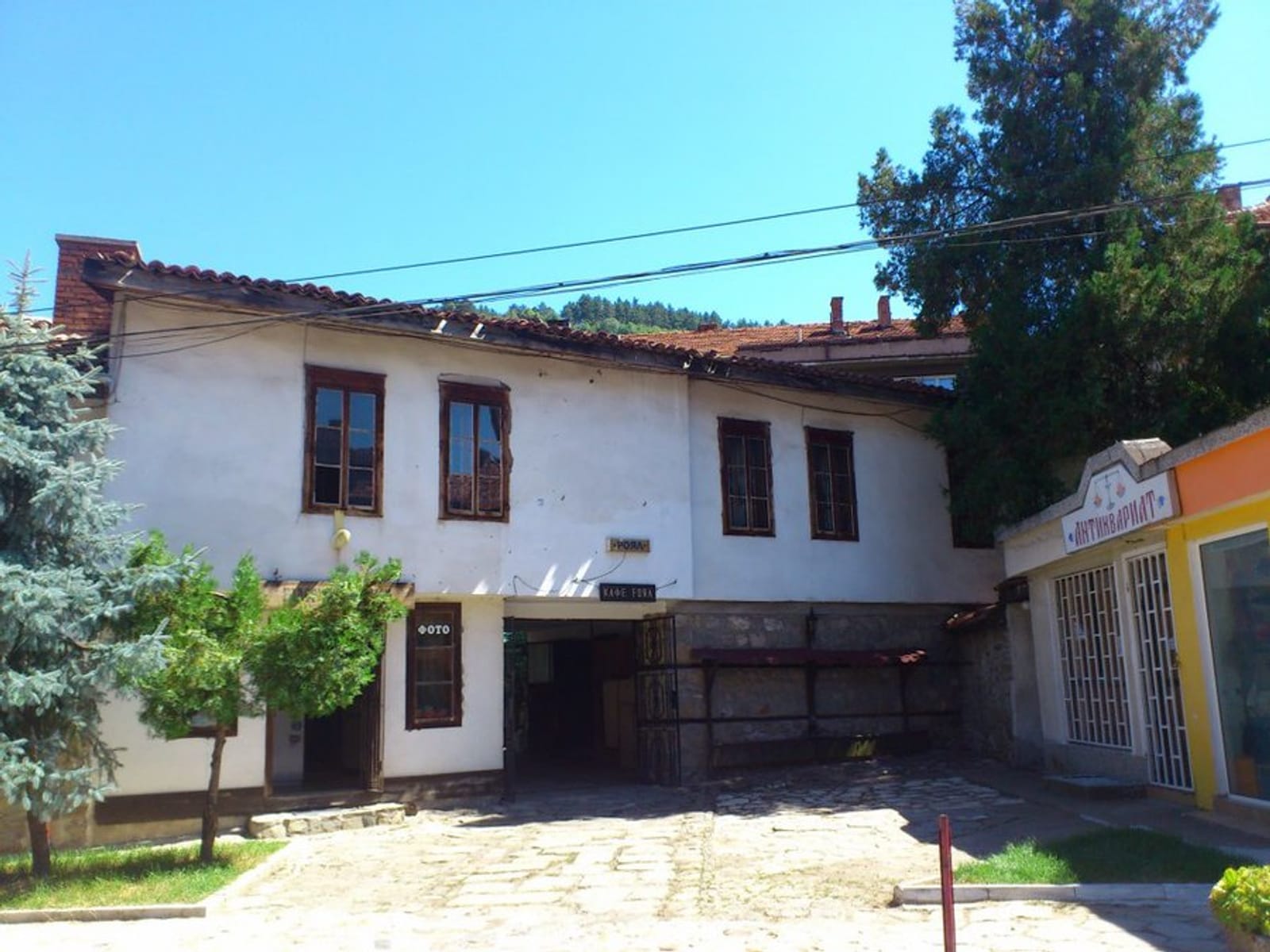
Location: The Doctor's House stands at 13 Gen. Krum Lekarski Street, in the center of Kyustendil, south of the Church of the Dormition of the Theotokos ("Uspenie Bogorodichno").
History and Architecture
The house belonged to Ivancho Hristov Hekim and is known among the people of Kyustendil as The Doctor's House. Built in the 1850s, it is an exquisite example of Revival-era architecture, constructed of stone, timber, and lime plaster in a characteristic grey-blue color.
Distinctive features:
- Ground floor and apothecary: A stone ground floor with a massive double-leaf outer door. An authentic spitseria (apothecary) faces the street facade. The southwestern room on the upper floor is heated by a traditional dzhamal fireplace.
- Oriel storeys: The second floor impresses with its strongly projecting oriels above the entrance, which lend the building its characteristic Revival-era silhouette.
- Artistic decoration: The ceilings of the kyoshk (bay parlor) and of the upper rooms (southwestern and southeastern) are richly decorated with stylized geometric motifs depicting the sun, the world tree, and a latticed asma ceiling. Triangular pendentives with unique images of double-headed eagles are set into the corners.
- Surroundings: The Granitska House (mid-19th century) stands in the immediate vicinity, creating a group concentration of cultural heritage.